
Most TPRM programs start in a workbook, and for good reason. A shared spreadsheet costs nothing, every reviewer already knows how to use it, and a few hundred rows with a dozen columns will carry a small vendor list through its first examination. Nobody announces the day it stops working. The tabs multiply, and the answer to a regulator's question starts with "let me pull that together."
Below are the seven signs that a program has passed what spreadsheets can hold, in the order they usually appear, from a fragmented inventory through to the board pack. Each comes with the symptom you will recognize, what it is costing you, and the fix.
Score yourself as you read. One point per sign.
The Short Answer
A TPRM program has outgrown spreadsheets when the workbook can no longer answer a regulator's question the same day: the inventory lives in several files, questionnaires go out by email, scores depend on the reviewer, nothing records who decided what, monitoring between reviews doesn't happen, onboarding takes weeks and the board pack takes days. Three or more of those signs means the spreadsheet already costs more than a platform would.
When a vendor management spreadsheet stops scaling
Fine at fifty vendors, failing at five hundred
A vendor management spreadsheet does three jobs well: it lists who you work with, it records what you asked them, and it holds a score. Under about a hundred third parties, with one or two reviewers and an annual cycle, that is most of a TPRM program. The Interagency Guidance on Third-Party Relationships (OCC, FDIC and Federal Reserve, June 2023) names no tool anywhere. It asks for practices "commensurate with the banking organization's size, complexity, and risk profile," and a small program run honestly in Excel can meet that bar.
Scale changes the math. Add a second business unit, a hundred more vendors, a fourth-party question and a second regulator, and the workbook starts doing jobs it was never built for: workflow, evidence, monitoring and reporting. Each of those gets handled by a person instead, and that person's hours are the real license fee. The downside is not abstract either. IBM's Cost of a Data Breach Report 2026 puts the global average cost of a breach at $4.99 million, a 12% increase over the prior year and a record high, and the same IBM data breach report finds that organizations making extensive use of AI and automation in security saved $1.93 million per breach compared with those using none.
Treat the seven signs below as a test. Give your program one point for each sign you recognize, then read the score.
| Score | Reading | Next step |
|---|---|---|
| 0 to 2 | Spreadsheets still fit | Tighten the template, add version control, calendar the reviews |
| 3 to 4 | You are paying for a platform in headcount | Scope a migration this budget cycle, starting with the inventory |
| 5 to 7 | The workbook is a finding waiting to happen | Move critical vendors first, keep the sheet read-only during cutover |
Vendor inventory spread across spreadsheets & inboxes
Nobody holds the whole list
An examiner's first request is the list. Under the guidance's Documentation and Reporting section, the lead example of effective documentation is "a current inventory of all third-party relationships (and, as appropriate to the risk presented, related subcontractors) that clearly identifies those relationships associated with higher-risk activities, including critical activities." Note the word current. A list reconciled once a year against accounts payable is not current, and an inventory split between procurement's tracker, InfoSec's SaaS list and a shared inbox is not one list.
You will know this sign by the question that follows it. "Is Northwind on the list?" takes a meeting to answer. Someone searches three files and an email thread, finds two entries with different owners, and nobody can say whether the subcontractor it uses for hosting was ever screened.
What it costs is the gap between the vendors you manage and the vendors you have. Every third party in that gap was never tiered, never screened and never assessed, and in a breach it is the one you learn about from the vendor's lawyer. The fix is structural rather than clerical:
- One inventory, with every other list retired or made read-only.
- An owner, a risk tier, a criticality flag and a lifecycle status on every row.
- Fed by intake, never by a quarterly sweep of invoices.
- Before writing "merge the spreadsheets" as the fix, read the next six signs.

Questionnaires chased by email every renewal
Same questions, same inbox, every year
Picture the renewal month. An analyst exports the vendors due, attaches last year's questionnaire to forty emails, and spends the next six weeks sending reminders. Responses arrive as spreadsheets with the columns rearranged, a PDF of a SOC 2 Type II that expired in March, and one vendor's reply that simply says "same as last year." Then the answers get copied, by hand, into the master sheet.
Due diligence results and "risk and performance reports required and received from the third party as part of ongoing monitoring" are on the guidance's list of documentation a program should hold. Nothing in it expects them to be re-collected from scratch each cycle or typed in by hand. Of the seven costs this one is the easiest to put a number on: vendors due times hours per questionnaire, plus the validation nobody does because the collection ate the time.
Security questionnaire automation fixes the chase in three places. The request goes out from the platform with a due date and a visible status, so reminders stop being a job. Prior answers and public evidence pre-fill the next version, so the vendor confirms rather than retypes. And the response lands as structured data against the vendor record instead of as an attachment. Certa's Pre-Fill Agent does the second of those, pulling third-party data from websites, news and documents to pre-populate forms and DDQs. A global life sciences leader with 50,000+ third parties runs 1,000+ monthly third-party requests automated that way, with DDQ pre-fill across 20 risk domains.
Risk scores that differ by reviewer
Two analysts, two tiers, one vendor
Every vendor risk assessment template has a scoring tab, and every scoring tab has a column of judgment calls. Inherent risk: high, medium or low. Data sensitivity: a dropdown. Criticality: whatever the business owner wrote on the intake form. Two careful reviewers reading the same SOC 2 will land a notch apart, and in a spreadsheet nothing reconciles them.
Tiering carries the whole life cycle in the guidance, which expects "more comprehensive and rigorous oversight and management of third-party relationships that support higher-risk activities, including critical activities." NYDFS Part 500 makes the same demand of covered entities: third-party policies must address "the identification and risk assessment of third-party service providers" and "periodic assessment of such third-party service providers based on the risk they present" (section 500.11(a)). A tier that moves with the reviewer breaks both. The critical vendor that scored one notch low gets the light review, and the examiner who samples ten files finds the inconsistency in the first three.
Fix the method before the tool. Write the scoring rules down as rules, weight them, and decide which single answers force a tier regardless of the total:
- Data classes the vendor touches, and whether any of it is customer or nonpublic information.
- Access type: network, system, physical or none.
- Spend band, geography and how easily the vendor could be substituted.
A spreadsheet can hold those rules in formulas, and that is a reasonable interim step. What it cannot do is apply them to every vendor automatically, log who overrode the result and why, or re-score when an input changes. That is the point at which the template has to become a workflow.

No audit trail for regulators or internal audit
Evidence rebuilt the week before the exam
A spreadsheet records the current value of a cell. It does not record that the cell said Tier 1 in February, that someone changed it to Tier 2 in April, or why. When internal audit asks how a vendor was approved, the answer gets reconstructed from emails, screenshots and memory, and reconstruction is what the examiner writes up.
Two expectations make this a program-level problem rather than an admin one. The guidance calls for "periodic independent reviews to assess the adequacy of its third-party risk management processes," including "whether the banking organization's processes and controls are designed and operating adequately," and internal audit cannot test operating effectiveness against a file with no history. It also expects documentation "throughout their life cycle": planning and risk assessments, due diligence results, executed contracts, remediation plans, monitoring reports and board reporting.
A defensible third party risk management program treats every decision as evidence at the moment it is made: who screened, what the hit was, who cleared it, on what basis, and when. That sentence is the fix. If your workbook cannot produce it for a vendor approved eighteen months ago, no amount of tab discipline will, and the migration case writes itself.
Continuous monitoring that never happens
Annual reviews, eleven blind months
Every policy says continuous monitoring. Open the workbook and look for the column that changed last week. The guidance is specific: ongoing monitoring exists to "escalate significant issues or concerns, such as material or repeat audit findings, deterioration in financial condition, security breaches, data loss, service interruptions, compliance lapses, or other indicators of increased risk," and it may run "on a periodic or continuous basis," with more frequent monitoring where critical activities are involved. A spreadsheet can only be updated by a person, so in practice the frequency is however often someone remembers.
What that costs shows up as lag. A security rating slides for two months before the annual questionnaire catches it. A supplier's going-concern qualification sits in its filings long before it reaches your sheet. A sanctions designation lands on a vendor's owner and nobody re-screens until renewal. Certa's guide to continuous monitoring priorities starts from the KPIs tied to your business goals and the regulations that apply to you, and for most programs the honest sequence is the critical tier first, across cyber, financial and sanctions, before anything else.
- Data: ratings, financial health, adverse media and watchlists arriving without a request.
- Thresholds: one per signal, written down, that opens a review when crossed.
- Owner: a named person who receives the review, not a distribution list.
Without the second and third parts, a feed is just another tab.
Onboarding cycle times measured in weeks
Intake to live takes a quarter
Onboarding is where the spreadsheet's hidden costs become visible to the rest of the company. A request arrives by email. Procurement keys it into the tracker, InfoSec sends its questionnaire, legal reviews the contract after InfoSec is done, and finance validates banking details after legal is done. Each handoff waits in someone's inbox. Certa's procurement page describes the result plainly: "a single high-risk vendor stalls an entire onboarding queue for weeks."
The business does not wait. It signs anyway, pays through an expense report, or picks a vendor already in the system regardless of fit, and each of those is a control failure the spreadsheet caused by being slow. Measure cycle time from request to approved, by tier, and compare it with what the sequence of reviews actually requires. The difference is queue time, and queue time is what tprm tools remove.
Three categories of tooling get sold as the answer, and they are not the same thing. Certa's infographic on automation vs orchestration vs AI draws the line between them. Automation does a single task without a person, orchestration sequences many tasks and teams on one record, and AI makes the judgment calls that used to need an analyst. Onboarding cycle time is mostly an orchestration problem. One US manufacturer took supplier onboarding from 6 to 12 months to 4 weeks on Certa, and Uber reported on-time supplier payments up from 40% to 95% with a six-week rollout and 50% lower operating costs.

Board reporting that takes days to assemble
The pack is stale on arrival
The guidance puts the board at the top of the program: it "has ultimate responsibility for providing oversight for third-party risk management and holding management accountable," and it looks for "appropriate periodic reporting on the banking organization's third-party relationships, such as the results of management's planning, due diligence, contract negotiation, and ongoing monitoring activities." None of that says a quarterly deck, but a quarterly deck is what a spreadsheet-based program produces, because the data has to be stitched by hand.
Certa's page for risk teams describes the symptom in one line: "Pulling a defensible risk picture for the board means weeks of stitching exports together by hand." The cost is subtler than the hours. By the time the pack is built, the numbers in it describe a portfolio that has already moved, so the committee decides on a snapshot of a snapshot.
A vendor risk management program at scale answers three board questions on demand:
- How many critical vendors have open high-severity findings, and how old is the oldest?
- Which concentration exposures have no tested substitute?
- What changed since the last meeting?
If each of those takes a day of exports, that is the seventh sign, and the one your CRO notices first.
How Certa replaces spreadsheets with TPRM automation
One record, every job the sheet did
Choosing third party risk management software after years in a workbook is partly a buying decision and partly an admission about which of the seven jobs the spreadsheet was quietly failing. Certa's own list of third-party risk management software factors (ease of use, functionality, governance maturity, scalability, integrations, cost) is a fair place to start the evaluation. What tprm automation changes, in Certa's own description of periodic, manual TPRM against its approach, fits in one table.
| Job the spreadsheet did | Periodic, manual TPRM | Certa |
|---|---|---|
| Reassessment | Annual, point-in-time reassessments | Real-time, continuous monitoring |
| Onboarding | 6 to 12 month onboarding | Onboarding in about 4 weeks |
| Inventory | Siloed across 6 systems and 8 to 10 teams | One platform, one source of truth |
| Questionnaires | Static questionnaires chased over email | AI-prefilled questionnaires and automated decisions |
Underneath the table, the mechanics map onto the seven signs. The inventory becomes one register, scored across seven risk domains and monitored continuously, so that, in Certa's words, "your team doesn't work the whole portfolio, it works the rows that changed." Questionnaires are pre-filled by the Pre-Fill Agent. Periodic assessment is "tuned to each vendor's risk tier," and the audit trail is built in rather than bolted on: "every screen, adjudication, and disposition is captured with documented rationale, citations, and timestamps, immutable and exportable on demand." Between reassessments, monitoring pulls live data from BitSight, Black Kite, Rapid Ratings and Interos. The Certa platform overview lays out the modules and the 130+ integrations behind that. Run this way, a third party risk management platform becomes the system of record, and the old workbook goes read-only for a quarter as the reconciliation base.
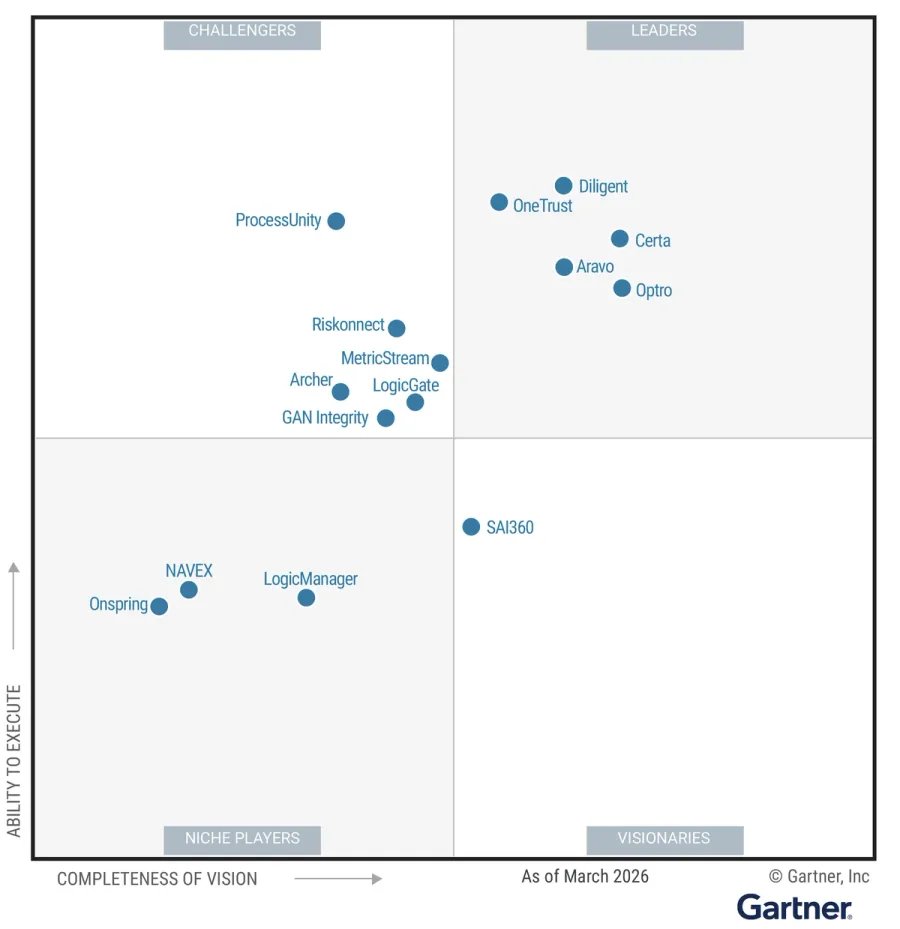
Two results matter most to a team leaving spreadsheets. A web-infrastructure leader consolidated from 6 systems to 1, bringing 8 to 10 teams onto one platform, which is the inventory and audit-trail problem solved in one move. Honeywell consolidated third-party onboarding and monitoring on Certa, eliminating manual handoffs across teams and regions, with ~50,000 sales hours saved annually. Certa was named a Leader in the 2026 Gartner® Magic Quadrant™ for Third-Party Risk Management Tools for Assurance Leaders.
For any vendor risk management software evaluation, the practical test is simpler than a quadrant. Ask the vendor to produce, live, the audit trail for a single approval and the board view for the critical tier. If either takes a day, you have found a nicer spreadsheet.
Sources
- OCC, FDIC and Federal Reserve, Interagency Guidance on Third-Party Relationships: Risk Management, 88 FR 37920 (June 9, 2023)
- OCC Bulletin 2023-17, Third-Party Relationships: Interagency Guidance on Risk Management (June 6, 2023)
- NYDFS, 23 NYCRR Part 500 as amended November 1, 2023, section 500.11
- IBM and Ponemon Institute, Cost of a Data Breach Report 2026
TPRM spreadsheet migration questions
Short answers for teams deciding whether, and when, TPRM software replaces the workbook.
What Should TPRM Software Do That Spreadsheets Can't?
Four things: hold one inventory with an owner, tier and lifecycle status per vendor, run questionnaires and approvals as tracked workflows rather than email threads, apply scoring rules the same way every time with overrides logged, and record every decision with rationale and timestamp as it happens. Continuous monitoring from live feeds and board reporting from the same record follow from those four. A tool that only stores the spreadsheet's columns in a database is doing none of them.
Is a Vendor Risk Assessment Template Enough for a Small Program?
Often, yes. A program with under about a hundred third parties, one or two reviewers and an annual cycle can meet the Interagency Guidance's expectation of practices "commensurate with the banking organization's size, complexity, and risk profile" with a disciplined template, a review calendar and version control. The template stops being enough when a second business unit, a second regulator or a critical tier that needs monitoring between reviews arrives, which is usually the first three signs above showing up together.
When Does a TPRM Program Need Dedicated Tools?
When the spreadsheet's hidden labor exceeds the cost of a platform, which tends to happen at three or more of the seven signs. Practical triggers: more than one reviewer scoring vendors, any critical vendor that needs monitoring between annual reviews, an internal audit or regulator request that took more than a day to answer, or onboarding cycle times the business has started routing around. Programs examined by the OCC, FDIC, Federal Reserve or NYDFS tend to hit the audit-trail trigger first.
How Long Does It Take to Move Off Spreadsheets?
Weeks for the core, not quarters, provided the inventory is cleaned first. Certa's own figures: pre-trained AI customized to a customer's frameworks typically takes a few weeks, Uber's rollout took six weeks, and one large US firm automated its entire bespoke TPRM process in 2 days using Certa AI. Plan the sequence as inventory, then critical-tier workflows and scoring, then monitoring feeds, and keep the old workbook read-only as the reconciliation base for one quarter.
TPRM Articles
Keep reading

TPRM
Streamlining Due Diligence: Automating Third Party Risk Management
 Certa · September 1, 2025

TPRM
Cybersecurity in Third Party Risk Management: Protecting Your Digital Assets
Certa · August 31, 2025

TPRM
Third-Party Risk Management Response: Preparing Your Business for Vendor Breaches
Certa · August 28, 2025