
An annual reassessment tells you what was true when the questionnaire came back. Your exposure moved the day after. In June 2023 the OCC, FDIC and Federal Reserve issued the Interagency Guidance on Third-Party Relationships, which expects ongoing monitoring that can "escalate significant issues or concerns, such as material or repeat audit findings, deterioration in financial condition, security breaches, data loss, service interruptions, compliance lapses, or other indicators of increased risk." Read that sentence twice. It is a KRI program in one line.
Below are the 12 indicators mature TPRM teams actually put in front of a risk committee, in rough lifecycle order: assessment hygiene, structural exposures, live signals, then the two that sit outside the risk team's direct control. Each comes with what to measure and an example threshold.
Treat every threshold as a starting point to tune against your own risk appetite. Where a regulator sets the number, the entry says so and cites it.
The Short Answer
Key risk indicators for third-party risk are forward-looking measures, each with a threshold, that warn when a vendor's exposure is rising before it becomes an incident. The 12 most useful cover overdue assessments, fourth-party and concentration exposure, SLA breaches, open findings, sanctions hits, security rating drops, financial decline, expired documents, disclosed breaches, shadow vendors and forced labor exposure.
Key risk indicators for vendor management explained
Leading signals, not last year's score
Key risk indicators are metrics that give an early signal of rising risk exposure. COSO's thought paper on the subject, written by the ERM Initiative at NC State (Beasley, Branson and Hancock, December 2010), separates them from performance measures by tense: KPIs "mostly focus on results that have already occurred," while KRIs "provide timely leading-indicator information about emerging risks." The Wikipedia risk indicator overview adds ISACA's test: exposure beyond the defined risk appetite.
Key risk indicators for vendor management apply that logic to a population you don't control. You can't see inside a supplier's change board. You can see its security rating slide 60 points in a month or a sanctions screen light up on one of its owners. Good kri examples in TPRM share three traits: the data arrives without asking the vendor, the threshold was set in advance, and a named person owns the response.
Most of the vendor risks worth monitoring fall into one of seven domains: operational and resilience, infosec and cyber, compliance and legal, financial and credit, reputational, geopolitical, and ESG. Every one of them appears below.

Critical vendors with overdue risk assessments
Assessment hygiene on your highest tier
First among these key risk indicators examples is the least glamorous one, and the one examiners find fastest. Under the Interagency Guidance, "more comprehensive or frequent monitoring is appropriate when a third-party relationship supports higher-risk activities, including critical activities," and each institution defines critical for itself, starting with activities that could "cause a banking organization to face significant risk if the third party fails to meet expectations." NYDFS Part 500 goes further for covered entities and requires "periodic assessment of such third-party service providers based on the risk they present" (section 500.11(a)(4)).
Measure it as a count and a share: how many critical vendors are past due, and what fraction of the tier that represents. A common starting point is zero Tier 1 vendors more than 30 days overdue and under 5% of Tier 2 past 60 days. When it trips, fix the schedule first. Cadences get set at onboarding and never tuned to the tier.
Fourth party risk from undisclosed subcontractors
What your vendors did not tell you
Fourth party risk is the exposure one hop past your contract. Under the Interagency Guidance, due diligence covers "the volume and types of subcontracted activities and the degree to which the third party relies on subcontractors." DORA (Regulation (EU) 2022/2554, applying since 17 January 2025) is more direct: Article 30(2)(a) requires every ICT contract to state whether subcontracting of a critical or important function "is permitted and, when that is the case, the conditions applying to such subcontracting."
- No subcontractor or sub-processor list on file for a critical vendor.
- A list older than 12 months, or one contradicted by your ratings feed and contract notices.
- A critical subcontractor you learned about from the news, an incident or an invoice.
Count those gaps across Tier 1. A program might trigger at 10% of the tier with no current list, and at any single undisclosed critical subcontractor. Respond through the contract, using the notification clause the guidance recommends for "use of subcontractors, key personnel changes, or other business initiatives."
Concentration risk across critical suppliers
Too much riding on one provider
Concentration risk hides inside individually sound relationships. Each vendor passed diligence. Together, three of them run on the same cloud sub-processor in the same region, and one outage takes down payments, statements and the contact center at once. DORA Article 29(1) names two conditions to weigh before signing: a provider "that is not easily substitutable," and multiple critical arrangements "with the same ICT third-party service provider or with closely connected ICT third-party service providers." US guidance calls it "dependency on a single provider for multiple activities."
- Map every critical function to its provider, that provider's key subcontractors and its delivery region.
- Count the functions with no tested substitute.
- Count the providers that appear under three or more critical functions.
Either count above zero is the trigger. Certa's guide to concentration risk in supply chains walks through the mapping in detail. DORA Article 28(8) sets the response: exit strategies for every ICT service supporting a critical or important function, so the entity can leave "without disruption to their business activities."
SLA breach frequency on critical services
Performance slipping before it fails
An sla breach is the most honest leading indicator you own, because the vendor reported it under contract. One missed availability target is noise. Twice in a quarter is a trend, and it tends to precede the larger failure. Performance measures in the contract, per the guidance, "can be used to monitor performance, penalize poor performance, or reward outstanding performance." DORA Article 30(2)(e) requires "service level descriptions" in every ICT contract.
Track two numbers: breaches per critical vendor per quarter, and repeats on the same SLA. Two breaches of one metric inside a rolling 90 days is a reasonable starting trigger, as is any single breach with customer impact. Feed the result into vendor scorecards & performance metrics so the business owner sees it, not only the risk team. Escalation runs from service credit, to a dated remediation plan, to the termination right the contract should already hold.
Open findings past remediation deadlines
Findings that stopped moving
A finding with a passed due date and no new evidence is being tolerated, whatever the tracker says. Ongoing monitoring, per the guidance, escalates "material or repeat audit findings," and contracts should let you "require timely remediation" when issues surface. Repeat is the operative word. Examiners read a findings log looking for the same gap raised in two consecutive reviews.
Weight the count by severity and age. Any high-severity finding more than 30 days past its date is a sensible trigger, as is an overdue share above 20% of the open book. When it trips, go to the business owner with the remediation clause in hand and record the decision either way.
A documented risk acceptance with rationale is defensible. Silence is what gets written up.
Sanctions & adverse media hits on active vendors
Screening that keeps running after approval
Screening at onboarding answers one day's question. Lists change daily, and ownership changes without telling you. OFAC's 50 Percent Rule treats entities "directly or indirectly owned 50 percent or more in the aggregate by one or more blocked persons" as blocked themselves, so a vendor can become a sanctions problem through a shareholder you never screened.
Two measures matter here. Confirmed hits, where any one is a trigger. And the queue of unresolved alerts, measured in days to disposition, which is where programs drown. Certa's Adjudicate Agent makes "confidence-scored, explainable calls on sanctions and adverse media hits, so analysts stop chasing false positives," with the rationale logged against each disposition. Whatever tool you run, keep the human decision and the citation, because the regulator will ask why a hit was cleared and by whom.

Security rating drops below threshold
A number that moves between audits
A SOC 2 Type II report describes a period that ended months ago. An external security rating describes last night. Bitsight's published methodology places organizations on a scale of 250 to 900, "with 250 being the lowest measure of security performance and 900 being the highest," rounds down to the nearest ten points, and runs its normalization "daily to reflect shifts in the underlying distributions." Black Kite grades vendors on a letter scale. Either feed gives you a daily number on a vendor that otherwise reports once a year.
- Floor: the rating below which a Tier 1 vendor gets an out-of-cycle assessment, whatever the cause.
- Velocity: the drop, in points over 30 days, that triggers a look even while the vendor sits above the floor.
NYDFS covered entities will recognize the logic. Section 500.11 asks for assessment of "the continued adequacy of their cybersecurity practices," and a ratings feed is the cheapest evidence that you looked between questionnaires.
Financial health decline in key suppliers
Insolvency rarely arrives unannounced
Supplier failure is a slow signal that gets read late. On what to read, the guidance lists "audited financial statements, annual reports, and filings with the U.S. Securities and Exchange Commission," plus "pending litigation, unfunded liabilities, reports from debt rating agencies." It names "deterioration in financial condition" as an issue ongoing monitoring should escalate. DORA Article 29(2) adds insolvency: "duly consider the insolvency law provisions that would apply in the event of the ICT third-party service provider's bankruptcy."
Pull the signal from a data provider rather than an annual request for financials. For critical suppliers, a two-notch downgrade, a going-concern qualification or a commercial credit score crossing the program floor are reasonable triggers.
Respond with a contingency review: a second source, data escrow, step-in rights, and whether the exit plan in your DORA register would still work this quarter.
Expired certifications & insurance documents
Evidence with an end date
Every certificate of insurance, SOC 2 bridge letter, ISO 27001 certificate and professional license carries an expiry date, and most programs discover the lapse at the next annual review. On insurance, the guidance is specific: evaluating coverage "helps a banking organization determine the extent to which potential losses are mitigated," and contracts should fix the "amounts of insurance" a vendor must hold.
- Count by document type: COI, SOC 2 or SOC 1, ISO 27001, cyber coverage, and any license the service depends on.
- Count by tier, with critical vendors reported on their own.
- Example threshold: under 5% of the tier lapsed at month end.
This is one of the few KRIs that can hit zero and stay there. A renewal reminder 60 days ahead, plus a rule that an expired COI on a critical vendor blocks the next invoice, usually does it.

Data breaches disclosed by third parties
Notice windows the regulator wrote
This indicator has clocks attached, and regulators set them. Under HIPAA, a business associate must notify the covered entity "without unreasonable delay" and "in no case later than 60 calendar days after discovery of a breach" (45 CFR 164.410). NYDFS Part 500.17(a) gives covered entities 72 hours to notify the Department after determining a cybersecurity incident has occurred "at the covered entity, its affiliates, or a third-party service provider." SEC registrants disclose a material cybersecurity incident on Form 8-K Item 1.05 within four business days of the materiality determination. Those are outer limits, and your KRI measures three gaps:
- Breaches reported by vendors that touch your data. Any one trips the indicator by definition.
- Time from the vendor's discovery to your notice. Later than the contract window trips a second indicator, about the vendor rather than the event.
- Time from your notice to any filing you owed, against the regulatory clock that applies to you.
Shadow vendors onboarded outside procurement
The inventory you did not approve
Governance, in the guidance, starts with "a current inventory of all third-party relationships." A shadow vendor lives in accounts payable, in an expense report or in single sign-on logs but nowhere in that inventory, so it was never tiered, screened or assessed.
Reconcile monthly. Match the vendor master and card spend against the inventory, then match SSO and OAuth app logs against it too, since a free SaaS tool with access to customer data is a third party whether or not anyone paid for it. Any unlisted vendor with system or data access is a trigger, as is unlisted spend above 2% of the total. Make the response an expedited intake rather than a reprimand, or the next one stays hidden.
ESG & forced labor exposure in the supply chain
Obligations that reach past tier one
Forced labor exposure became a customs problem in the United States on June 21, 2022, when the Uyghur Forced Labor Prevention Act's rebuttable presumption took effect. CBP presumes that goods "mined, produced, or manufactured wholly or in part" in the Xinjiang Uyghur Autonomous Region, or by an entity on the UFLPA Entity List, are barred from import under 19 U.S.C. 1307, and the importer carries the burden of rebutting it. Germany's Supply Chain Due Diligence Act (LkSG) has applied to companies with at least 1,000 employees since January 1, 2024, with a documented risk analysis, a complaints procedure and reporting among its obligations.
Count suppliers mapped to a high-risk region or a listed entity at every tier you can see, plus the share of in-scope suppliers with an overdue forced labor or ESG attestation. One entity-list link is a trigger. The attestation share is tunable, and 5% is a common starting point. Respond by tracing, then either clear the supply path with evidence or change the source.
Tracking KRI metrics with Certa
One register, thresholds built in
A KRI program fails on plumbing long before it fails on ideas. These 12 indicators draw on at least six data sources, and a key risk indicators dashboard that depends on someone exporting each of them monthly is stale on arrival.
The Certa TPRM suite runs these kri metrics as continuous monitoring on one register. Certa scores every third party across seven risk domains and monitors them continuously, so that, in Certa's words, "your team doesn't work the whole portfolio, it works the rows that changed." Periodic assessments are "tuned to each vendor's risk tier," and every screen, adjudication and disposition is "captured with documented rationale, citations, and timestamps, immutable and exportable on demand." One web-infrastructure leader consolidated 8 to 10 teams and six systems onto that single platform, which is the precondition for a dashboard anyone trusts.
Here is a starting dashboard. Owners are typical, and every threshold is an example to tune against your risk appetite.
| KRI | Source | Threshold | Owner |
|---|---|---|---|
| Overdue reviews | Review calendar by tier | Zero Tier 1 over 30 days | Vendor risk |
| Unknown fourth parties | Contract notices, sub-processor lists | Over 10% of Tier 1 with no list | Vendor risk |
| One-provider exposure | Inventory map by provider and region | Any critical function with no substitute | Resilience |
| SLA breaches | Vendor SLA reports | Two of one SLA in 90 days | Business owner |
| Overdue findings | Findings register | Any high severity 30 days past due | Vendor risk |
| Sanctions hits | Screening feed, UBO data | Any match; alerts open over 5 days | Compliance |
| Rating drops | Bitsight or Black Kite feed | 50-point drop in 30 days, or below floor | InfoSec |
| Financial decline | Credit data provider | Two-notch downgrade or going concern | Procurement |
| Expired documents | Document store with expiry dates | Zero Tier 1 lapses over 15 days | Vendor risk |
| Vendor breaches | Vendor notices, incident log | Any breach touching your data | InfoSec, Legal |
| Shadow vendors | AP, card spend, SSO logs | Any with data access; over 2% of spend | Procurement |
| Forced labor links | Supply chain map, entity lists | Any listed entity; over 5% overdue | ESG, Compliance |
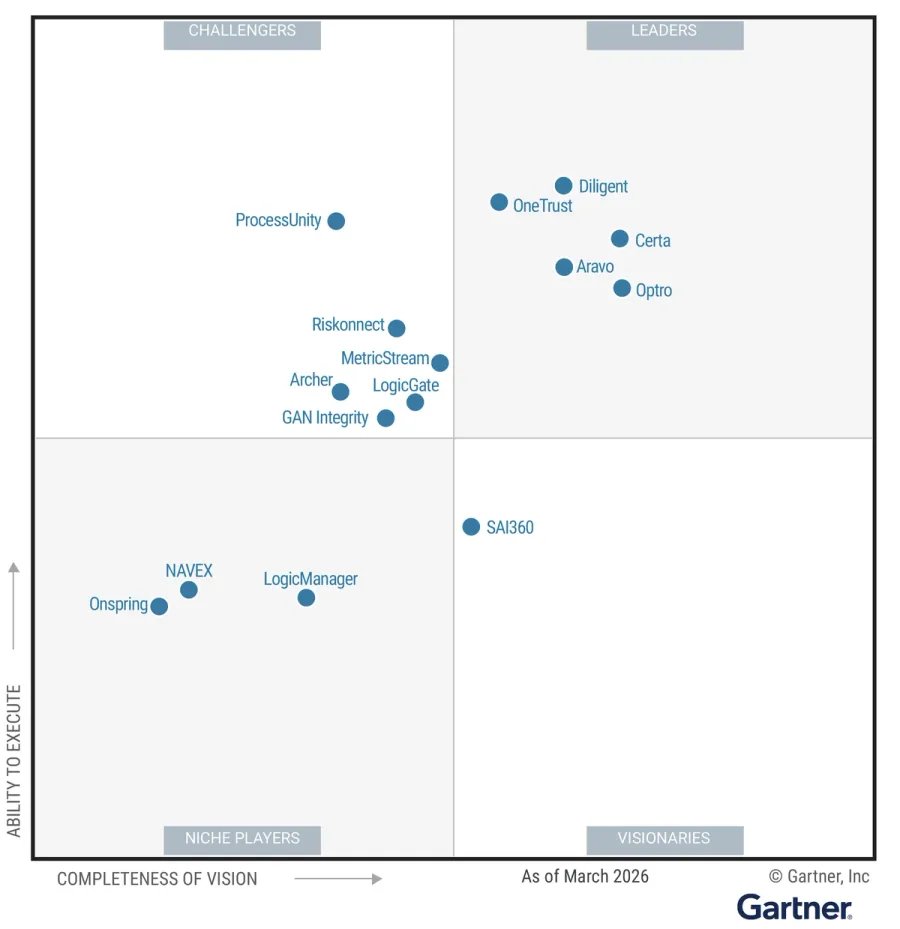
Certa was named a Leader in the 2026 Gartner® Magic Quadrant™ for Third-Party Risk Management Tools for Assurance Leaders. For a KRI program, the practical point is that the monitoring and the evidence trail come from the same system the indicators do.
Sources
- OCC, FDIC and Federal Reserve, Interagency Guidance on Third-Party Relationships: Risk Management, 88 FR 37920 (June 9, 2023)
- OCC Bulletin 2023-17, Third-Party Relationships: Interagency Guidance on Risk Management (June 6, 2023)
- FDIC FIL-29-2023, Interagency Guidance on Third-Party Relationships: Risk Management (June 6, 2023)
- COSO, Developing Key Risk Indicators to Strengthen Enterprise Risk Management (Beasley, Branson and Hancock, December 2010)
- Wikipedia, Key risk indicator
- EUR-Lex, Regulation (EU) 2022/2554 (DORA), Articles 28, 29, 30 and 64
- NYDFS, 23 NYCRR Part 500 as amended November 1, 2023, sections 500.11 and 500.17
- OFAC FAQ 401, Entities Owned by Blocked Persons (50 Percent Rule)
- 45 CFR 164.410, Notification by a business associate (Cornell LII)
- SEC press release 2023-139, SEC Adopts Rules on Cybersecurity Risk Management, Strategy, Governance, and Incident Disclosure (July 26, 2023)
- U.S. Customs and Border Protection, Uyghur Forced Labor Prevention Act
- BAFA, German Supply Chain Due Diligence Act (LkSG) overview
- Bitsight, How Bitsight Calculates Security Ratings (Policy Review Board, January 2026)
Frequently asked questions about KRIs
Short answers to the questions risk committees ask when a KRI program starts.
KRI vs KPI: What Is the Difference?
A KPI measures how well something was done, and a KRI measures how likely something is to go wrong. COSO's KRI paper puts it in tense: KPIs "mostly focus on results that have already occurred," while KRIs "provide timely leading-indicator information about emerging risks." In vendor management, on-time delivery is a KPI and a rising count of SLA breaches on critical services is a KRI. The kri vs kpi distinction matters because a scorecard full of KPIs can look green the week before a vendor fails.
How Many Key Risk Indicators Should a TPRM Program Track?
Enough to cover the seven risk domains on your critical tier, and few enough that every one has an owner and a threshold, which in practice means 10 to 15 at program level. Third party risk management key risk indicators multiply fast once each business unit adds its own, so keep a short program-level set and let units track more locally. The 12 in this post are a defensible starting set for a regulated enterprise.
How Do You Set KRI Thresholds Against Risk Appetite?
Start from the risk appetite statement, translate it into a tolerance per risk domain, and set each KRI threshold at the point where that tolerance would be breached. COSO describes the mechanism as "mapping KRI measures to identified risk appetite and tolerance levels," with trigger points and action plans decided in advance. Use two levels, a warning that opens a review and a limit that forces escalation, then recalibrate after two quarters of real data.
What Belongs on a Key Risk Indicators Dashboard?
Each KRI with its current value, its threshold, its 90-day trend and its owner, filtered to the critical tier by default. Add the count of indicators in breach, the oldest unresolved breach, and a drill-down from each number to the vendors behind it. Leave out raw KPIs and vanity totals. The committee needs to see what changed since last month, not how many vendors you have.
TPRM Articles
Keep reading

TPRM
Streamlining Due Diligence: Automating Third Party Risk Management
 Certa · September 1, 2025

TPRM
Cybersecurity in Third Party Risk Management: Protecting Your Digital Assets
Certa · August 31, 2025

TPRM
Third-Party Risk Management Response: Preparing Your Business for Vendor Breaches
Certa · August 28, 2025