
A prime that can name its Tier 1 suppliers has answered the easy question. The hard ones sit two or three tiers down. Who owns the machine shop that cuts the bracket? Which distributor sold the obsolete microcontroller in the last lot? Did the sanctions list change this morning, and does the change touch anyone in the program? Certa's aerospace and defense page puts the problem in one line: "You can't secure a supply chain you can't see."
The rules assume you can. DFARS flows counterfeit part requirements to "contractors and subcontractors at all tiers." The CMMC program applies "throughout the supply chain at all tiers" to anyone handling federal contract information or controlled unclassified information. The ITAR counts a drawing emailed to the wrong engineer as an export. None of these regimes stops at the first contract you signed.
The ten strategies below run in rough order of dependency. Mapping comes first because every later strategy needs to know who is actually in the chain. Each entry names the risk, the rule or standard that governs it, and a first move a program can make this quarter.
The Short Answer
The ten supply chain risk strategies that matter most in aerospace and defense are sub-tier mapping, dual sourcing for single points of failure, counterfeit electronic parts avoidance under DFARS 252.246-7007 and 7008, obsolescence management, CMMC verification across subcontractors, ITAR and export control screening, foreign ownership reviews, financial health monitoring of small suppliers, critical minerals and concentration control under DFARS 225.7018, and real-time visibility with disruption alerts.
Why the aerospace supply chain needs its own risk playbook
A vendor list is not a map
Generic supply chain risk management was written for margin and delivery. It asks whether a supplier will ship on time and whether the price will hold. An aerospace supply chain carries a second set of questions that a commercial program never faces: whether a part is authentic, whether its data is controlled, whether the entity that made it is owned by a foreign government, and whether a sanctions designation three tiers down just became your problem.
The consequences are different in kind. An ITAR violation can end a company's ability to export defense articles, not only cost it a penalty. A counterfeit component is a flight safety event. A contractor under unmitigated foreign ownership, control or influence is ineligible for access to classified information under the NISPOM until the influence is negated or mitigated to the government's satisfaction.
So the supply chain risk management strategies that work here start from the regulatory surface rather than the cost surface, and they need supply chain risk management tools built to hold evidence a DCMA or DCAA reviewer will accept. Every entry below is written for a program that will be asked to prove it, not just to have done it.

Supply chain mapping down to sub-tier suppliers
Know who is actually in the chain
Every other strategy on this list fails without this one. You cannot screen an entity you have not identified, verify a CMMC status for a subcontractor you do not know exists, or dual source a part when you cannot see that both of your Tier 1 vendors buy the same forging from the same mill. NIST SP 800-161 Rev. 1, Cybersecurity Supply Chain Risk Management Practices for Systems and Organizations (May 2022, updated November 1, 2024), frames the discipline as "identifying, assessing, and mitigating cybersecurity risks throughout the supply chain," and the word throughout is the point.
Supply chain mapping in A&D runs part by part rather than vendor by vendor. Start with the bill of materials for the program's critical items and trace each to the entity that actually makes it, then to that entity's material and component sources. Ask each Tier 1 for its sub tier supplier list in the contract, with an update obligation when it changes. Fill the gaps with third-party illumination data rather than waiting on disclosures, because a supplier that will not name its sources is itself a finding.
- Tier the parts, not the vendors: sole-source, long-lead, ITAR-controlled and flight-critical items first.
- Record for each node the legal entity, site, country, ownership and what it supplies.
- Diff the map quarterly against disclosures, illumination data and your own purchase orders.
Dual sourcing for single-point-of-failure parts
Two qualified sources, one part
The map from entry one will surface a list of parts with exactly one qualified source. Some are unavoidable. A specialty forging or a radiation-hardened device may have one maker on earth. Many are not: they are single-sourced because qualification was expensive once and nobody revisited the decision after the program moved from development to sustainment.
Dual sourcing is a capital decision, so rank the list before you fund it. The supply chain resilience strategies that hold up weigh three things per part: the consequence of a stop (line idle, delivery slip, safety), the time to qualify a second source, and whether the two sources are genuinely independent. Two distributors drawing from one fab are one source with two invoices. Where a second source is not realistic, the fallback is a strategic buffer sized to the re-qualification lead time, and that buffer has to be documented as a deliberate risk acceptance rather than an accident of inventory.

Counterfeit electronic parts detection & avoidance
The DFARS system, flowed to every tier
This is the one strategy where DoD wrote the system for you. DFARS subpart 246.870 "prescribes policy and procedures for preventing counterfeit electronic parts and suspect counterfeit electronic parts from entering the supply chain," and the DFARS quality assurance rules require contractors subject to the cost accounting standards that supply electronic parts to "establish and maintain an acceptable counterfeit electronic part detection and avoidance system." Failure can mean disapproval of the purchasing system and withheld payments.
Clause 252.246-7007 lists twelve areas the system must cover with risk-based policies and procedures, and they read as a checklist for your supplier program:
- Training of personnel, and inspection and testing of electronic parts with acceptance and rejection criteria.
- Processes to abolish counterfeit parts proliferation and to maintain electronic part traceability.
- Use of suppliers in line with 252.246-7008, and reporting and quarantining of counterfeit and suspect counterfeit parts, including to GIDEP.
- Methods to identify suspect parts and rapidly determine whether they are counterfeit.
- Design, operation and maintenance of detection and avoidance systems, which may follow recognized standards such as SAE AS5553.
- Flowdown of the requirements to subcontractors, keeping current on counterfeiting trends, screening GIDEP and other credible sources, and control of obsolete electronic parts.
Clause 252.246-7008 sets the source hierarchy. Parts in production come from the original manufacturer, its authorized suppliers, or suppliers that obtain parts exclusively from those sources. A contractor-approved supplier is allowed only when those sources cannot supply the part, and the contractor then "assumes responsibility for the authenticity of parts provided by such contractor-approved suppliers." Where traceability to the original manufacturer cannot be established, the contractor carries inspection, testing and authentication under applicable industry standards. Both clauses flow down to subcontracts, including subcontracts for commercial products, so the counterfeit electronic parts question has to be asked of every tier that buys, sells or tests a device.
Obsolescence management for long-life programs
Parts that outlive their makers
Obsolescence is where counterfeit risk is born. A platform designed in 2004 and flying in 2040 will outlive most of the semiconductor lines it was built on. DFARS 252.246-7007 defines an obsolete electronic part as one "no longer available from the original manufacturer or an authorized aftermarket manufacturer," and item (c)(12) of the same clause makes "control of obsolete electronic parts" a required element of the detection and avoidance system, aimed at maximizing the availability of authentic, qualified parts.
Obsolescence management therefore belongs inside the supplier program rather than in a separate engineering silo. The practical loop is short. Monitor end-of-life and last-time-buy notices for every active device, decide per part between a lifetime buy, a qualified alternate, or a redesign, and record the decision with its date. The risk register entry for a part that went obsolete without a plan should read exactly like a finding, because the next purchase of that part will come from a broker and 252.246-7008 then puts the authenticity burden on you.
CMMC compliance verification across subcontractors
Status, level & affirmation, by tier
CMMC moved from program to contract clause on November 10, 2025, the effective date of the DFARS rule Assessing Contractor Implementation of Cybersecurity Requirements (90 FR 43560). Under 32 CFR 170.3(e) the rollout runs in four phases, Phase 1 beginning on that date and each later phase "one calendar year following the start date" of the one before it, with the DFARS prescription reaching all applicable solicitations and contracts on or after November 10, 2028. Level 1 maps to the fifteen safeguarding requirements of FAR 52.204-21, Level 2 to NIST SP 800-171 Rev. 2, and Level 3 to selected requirements from NIST SP 800-172.
The flowdown is explicit, and it is the part most supplier programs are not ready for. Section 170.23 applies the requirements to "prime contractors and subcontractors throughout the supply chain at all tiers that will process, store, or transmit any FCI or CUI." A subcontractor that handles only FCI needs Level 1 (Self). One that handles CUI needs at least Level 2 (Self), and Level 2 (C3PAO) when the prime's contract requires Level 2 (C3PAO) or Level 3 (DIBCAC). Clause 252.204-7021 then requires the prime, before award, to ensure the subcontractor has a current CMMC status at the level appropriate to the information flowed down, and requires an annual affirmation of continuous compliance in SPRS.
Cmmc compliance verification is therefore a data problem across the supply base: for every subcontract, the information type, the required level and assessment type, the subcontractor's CMMC unique identifier, and the date of its last affirmation. A spreadsheet can hold that for twenty suppliers. It cannot hold it for two thousand with option periods.
ITAR compliance & export control screening
Every supplier touching technical data
The International Traffic in Arms Regulations sit in 22 CFR Parts 120 through 130 and implement section 38 of the Arms Export Control Act. Two definitions drive supplier risk. Technical data under 22 CFR 120.33 includes information "required for the design, development, production, manufacture, assembly, operation, repair, testing, maintenance, or modification of defense articles," down to blueprints, drawings and photographs. And export under 120.50 includes "releasing or otherwise transferring technical data to a foreign person in the United States," the deemed export, with foreign person defined in 120.63 to cover any entity "not incorporated or organized to do business in the United States" and any natural person who is not a lawful permanent resident or protected individual.
So itar compliance in the supply chain starts before any shipment. A drawing attached to a request for quote is a release of technical data. A machine shop with a foreign national on the floor who can see the print is a deemed export question. Registration follows the same logic: 22 CFR 122.1 requires anyone in the United States "engaged in the business of manufacturing or exporting" defense articles to register with the Directorate of Defense Trade Controls, and "a manufacturer who does not engage in exporting must nevertheless register."
- Classify each purchased item and the data that accompanies it (USML category or EAR) before the RFQ goes out.
- Collect and date each supplier's DDTC registration and its technology control plan where foreign persons are employed.
- Screen the supplier and its owners against denied and restricted party lists at onboarding and continuously, not annually.
Foreign ownership & influence reviews
Who really controls the supplier
Under 32 CFR 117.11 a U.S. entity is under FOCI when "a foreign interest has the power to direct or decide issues affecting the entity's management or operations" in a way that could result in unauthorized access to classified information or adversely affect performance of a classified contract. Factors are weighed in the aggregate, and they include the "source, nature, and extent of FOCI" across "the immediate, intermediate, and ultimate parent entities" and whether a foreign government owns or controls the entity directly or indirectly.
Cleared entities report through the SF 328 and update it "when significant changes occur." Mitigation runs from a board resolution for minority holdings without board rights, to a security control agreement when a foreign interest has board representation but not control, to a special security agreement when the foreign interest effectively owns or controls the entity. The clearance side is DCSA's job. The supplier side is yours, because a Tier 2 that changes hands to a foreign parent does not stop shipping while the paperwork catches up.
Run beneficial ownership on cleared, sole-source and data-handling suppliers at onboarding, and watch for the changed conditions the rule itself lists: "a change in ownership, indebtedness, or a foreign intelligence threat." A debt facility from a foreign bank can be as relevant as a share sale.
Financial health monitoring of small suppliers
Distress shows up before default
The deepest tiers of a defense program are full of small companies with one or two products, a handful of customers and no public financials. They are also the ones most likely to be sole sources. A quiet exit, a distressed sale or a bankruptcy at that level rarely announces itself through the prime's procurement channel. It shows up as a late delivery, then as a changed remittance address, then as a new owner you never screened.
Monitor the signal rather than the annual request for statements. Payment behavior, legal filings, credit changes and employee count moves all precede a stop. Certa's platform pulls live financial health data from Rapid Ratings alongside security ratings from BitSight and Black Kite, so a critical provider's viability score sits in the same supplier profile as its CMMC status and ownership record, and a drop triggers a reassessment rather than waiting for next year's review. Whatever feed you use, pair it with the dual sourcing list from entry two: the small suppliers that are also sole sources are the ones a finance alert should route straight to a program manager.
Critical minerals & sourcing concentration
Magnets, metals & the 2027 date
DFARS 225.7018 restricts acquisition of covered materials, defined as samarium-cobalt magnets, neodymium-iron-boron magnets, tantalum metals and alloys, tungsten metal powder, and tungsten heavy alloy or any finished or semi-finished component containing it. Through December 31, 2026, the rule bars covered material "melted or produced" in a covered country (North Korea, China, Russia and Iran under 225.7001) and any end item manufactured there that contains one. Effective January 1, 2027, the restriction reaches back to covered material "mined, refined, separated, melted, or produced" in a covered country. Exceptions exist for acquisitions at or below the simplified acquisition threshold, items acquired and used outside the United States, certain COTS items and electronic devices, and nonavailability determinations, and the clause that carries the restriction is 252.225-7052.
The 2027 date turns a procurement rule into a mapping requirement. For a magnet, melted or produced is one tier of evidence, and mined and separated is two or three more. Specialty metals under 225.7003 add the long-standing requirement that specialty metals in aircraft, missile, ship, weapon system and ammunition components be melted or produced in the United States, with its own exceptions. Confirm the scope of each with counsel for the programs you run, because the exceptions matter as much as the rule.
Concentration is the same problem without a statute. Three suppliers that all buy their rare earth oxide from one separator in one province are one supplier for resilience purposes. Certa's guide to vendor concentration risks covers the mapping method. The A&D version adds country of origin for each covered material as a mandatory field on the supply chain map, so the 225.7018 answer and the concentration answer come from the same record.

Real-time supply chain visibility & disruption alerts
From annual review to live signal
Nine strategies produce a map, a set of clearances and a stack of attestations. All of it is true on the day it was collected. Supply chain visibility in the sense that matters means the map updates when the world does: a sanctions designation lands, a Tier 3 is acquired, a security rating falls, a port closes, a GIDEP alert names a part number you buy. NIST SP 800-161 treats cybersecurity supply chain risk as something managed throughout the supply chain and across the organization rather than at a single checkpoint, and the same logic applies to every risk domain on this list.
The operating model that works is review by exception. Every mapped node carries continuous screening against sanctions and denied party lists, a ratings feed where one exists, ownership monitoring and a disruption watch tied to its sites. The team does not reassess the whole base on a calendar. It works the nodes that changed, with the alert, the evidence and the decision captured in one record, because the DCMA question will not be whether you had a feed but what you did with the signal on the day it fired.
Running defense supply chain risk programs in Certa
Ten strategies, one supplier record
The ten strategies share a weakness. Each one needs the others' data, and in most programs that data lives in a procurement system, a compliance spreadsheet, an export control database and a security team's inbox. Certa for aerospace & defense is built to hold a defense supply chain on one record per third party across all tiers, with screening "that updates the moment the list does" and documentation "that holds up under DCMA, DCAA, and regulatory scrutiny." Its ten covered use cases for the sector are CMMC / NIST SP 800-171 / DFARS, ITAR / EAR export controls, sanctions and denied party screening, n-tier supply chain visibility, FOCI, forced labor under UFLPA, conflict minerals under Dodd-Frank 1502, AS9100 / ISO 9001 / REACH / RoHS / OSHA quality and environmental requirements, counterfeit part risk, and supply chain resilience.
Under the hood, the platform maps direct suppliers and their Tier-N sub-suppliers, pulls live data from BitSight, Black Kite, Rapid Ratings and Interos to keep risk profiles current between reassessments (Interos supplies the multi-tier supply chain mapping for fourth-party and concentration risk), and runs a Cyber Security Cert. (CMMC) Agent alongside the Adjudicate Agent that makes "confidence-scored, explainable calls on sanctions and adverse media hits." A global industrial manufacturer that consolidated supplier onboarding, due diligence and continuous monitoring on Certa cut onboarding from 90 days to 15. Here is how the strategies map to the platform:
| Strategy | Certa capability | Evidence it leaves |
|---|---|---|
| Sub-tier mapping | N-tier supply chain visibility, Interos multi-tier mapping | Entity, site, country and ownership per node |
| Dual sourcing | Supply chain resilience use case, concentration analysis | Sole-source register with risk acceptance |
| Counterfeit parts | Counterfeit part risk use case, supplier source tiering | Source hierarchy and traceability per supplier |
| Obsolescence | Supplier record fields and alerts on part status | Dated per-part decision trail |
| CMMC verification | CMMC / NIST SP 800-171 / DFARS use case, CMMC Agent | Level, status, UID and affirmation date per subcontract |
| ITAR screening | ITAR / EAR use case, sanctions and denied party screening | Registration, classification and screen results |
| FOCI reviews | FOCI use case, UBO screening | Ownership chain with change alerts |
| Financial health | Rapid Ratings feed in the supplier profile | Score history and triggered reassessments |
| Critical minerals | Conflict minerals and concentration mapping | Country of origin per covered material |
| Live visibility | Continuous screening, ratings feeds, review by exception | Alert, rationale and disposition with timestamps |
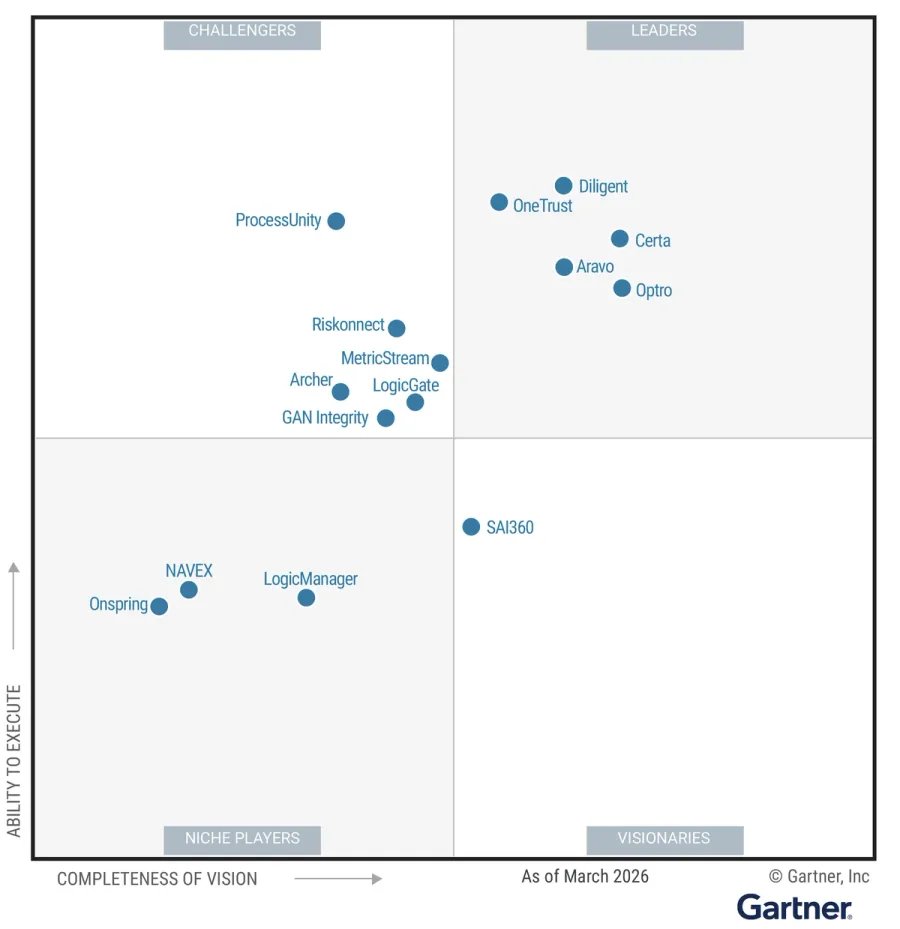
Certa was named a Leader in the 2026 Gartner® Magic Quadrant™ for Third-Party Risk Management Tools for Assurance Leaders. For a defense program, the practical test is simpler: when the reviewer asks who made the part and who owns the maker, the answer is one query, not one week.
Sources
- Acquisition.gov, DFARS Part 246 Quality Assurance, subpart 246.870 Contractors' Counterfeit Electronic Part Detection and Avoidance
- Acquisition.gov, DFARS 252.246-7007 Contractor Counterfeit Electronic Part Detection and Avoidance System (JAN 2023)
- Acquisition.gov, DFARS 252.246-7008 Sources of Electronic Parts (JAN 2023)
- eCFR, 32 CFR Part 170 Cybersecurity Maturity Model Certification (CMMC) Program
- Federal Register, DFARS: Assessing Contractor Implementation of Cybersecurity Requirements (DFARS Case 2019-D041), 90 FR 43560, September 10, 2025, effective November 10, 2025
- Acquisition.gov, DFARS 252.204-7021 Contractor Compliance with the Cybersecurity Maturity Model Certification Level Requirements (NOV 2025)
- eCFR, 22 CFR Part 120 International Traffic in Arms Regulations: Purpose and Definitions
- eCFR, 22 CFR 122.1 Registration: requirements, exemptions, and purpose
- eCFR, 32 CFR 117.11 Foreign Ownership, Control, or Influence (FOCI), National Industrial Security Program Operating Manual
- Acquisition.gov, DFARS Subpart 225.70, sections 225.7003 (specialty metals) and 225.7018 (certain magnets, tantalum, and tungsten)
- NIST, SP 800-161 Rev. 1, Cybersecurity Supply Chain Risk Management Practices for Systems and Organizations (May 2022, updated November 1, 2024)
Aerospace & defense supply chain risk questions
Short answers to the questions supplier risk leads at primes and subcontractors ask most.
What Are the Main Supply Chain Risk Management Strategies?
For aerospace and defense, the main strategies are sub-tier supply chain mapping, dual sourcing for single-point-of-failure parts, a counterfeit electronic parts system that meets DFARS 252.246-7007 and 7008, obsolescence management, CMMC verification across subcontractors, ITAR and export control screening, foreign ownership and influence reviews, financial health monitoring of small suppliers, critical minerals and concentration control, and continuous visibility with disruption alerts. Mapping comes first because each of the others needs to know who is in the chain.
How Deep Should Sub-Tier Supplier Mapping Go?
Deep enough to answer the rule that applies to each part, which is deeper than most programs assume. DFARS 225.7018 reaches back to where a covered magnet was mined and separated from January 1, 2027, counterfeit traceability runs to the original manufacturer under 252.246-7008, and FOCI factors weigh the immediate, intermediate and ultimate parent. A practical rule is to map sole-source, ITAR-controlled, flight-critical and covered-material parts to the point of origin, and everything else to the entity that actually makes it.
Does CMMC Apply to Every Subcontractor?
It applies to every subcontractor at any tier that will process, store or transmit federal contract information or controlled unclassified information on its own systems in performance of the contract, under 32 CFR 170.23. The level depends on the information: Level 1 (Self) for FCI only, at least Level 2 (Self) for CUI, and Level 2 (C3PAO) when the prime's contract requires Level 2 (C3PAO) or Level 3 (DIBCAC). Subcontracts solely for commercially available off-the-shelf items are excluded. The prime must confirm the status before award and the subcontractor must affirm annually in SPRS.
How Do Primes Track Counterfeit Parts Risk?
Through the detection and avoidance system DFARS 252.246-7007 requires, which covers twelve areas including supplier sourcing, traceability, inspection and testing, GIDEP screening and reporting, and control of obsolete parts. In practice that means tagging every supplier of electronic parts by its place in the 252.246-7008 source hierarchy, flowing both clauses to every tier that buys, sells or tests parts, and recording the test and authentication evidence whenever a part cannot be traced to its original manufacturer.
Supply Chain Articles
Keep reading

Supply Chain
Supply Chain Risk Management: Safeguard Your Operations Against Disruptions
 Certa · April 15, 2025

Supply Chain
German Supply Chain Act: Leveraging Data Integration for Risk Assessment
Certa · March 12, 2025

Supply Chain
Navigating UFLPA: Impact on Global Supply Chains
Certa · November 30, 2023